

MUCH ADO ABOUT NOTHING
Much Ado About Nothing – Production History
by Makayla Buckholz, Maddie Haddad, Saoirse Plafker, and Gianna Sandoval
Audrey Stanley, the director of Shakespeare Santa Cruz’s production of Much Ado about Nothing in 1987, cut three live horses from the show one day before opening night. Unless someone had been eagle-eyed enough to catch the advertisement in the program for the horse farm that had provided one of the horses, the audience was none the wiser. Critics unanimously praised Norvid Jenkins Roos’s elaborate set and Elaine Yokoyama Roos’s sumptuous costumes, which placed this production in the California Rancho period of the 1830s and 1840s, which Stanley described as a “very macho society,” during which “that sense of honor and virginity and soldiers with swords still happened.” Stanley hoped that the setting would resonate with audiences who grew up on the 1959 Western television series “Bonanza” and Rodgers and Hammerstein’s classic musical “Oklahoma!”
Presented alongside Much Ado that summer was Henry V, the final play of Shakespeare’s second tetralogy of history plays, and Stephen Sondheim and George Furth’s Company, which was the first musical that Shakespeare Santa Cruz had presented in its six years of operation. The season’s uniting theme was marriage: Benedick and Beatrice’s witty rivalry which transforms into romance, Claudio and Hero’s chaste courtship that takes a tragic turn, Henry V’s wooing of French princess Katherine, and Company’s chronically-single Robert’s increasing desire for someone to spend his life with. All three shows generated record-breaking crowds, including the largest crowd in Shakespeare Santa Cruz’s history for Much Ado About Nothing.
The season’s star actor was Paul Whitworth, a veteran of the Royal Shakespeare Company who was a visiting professor of theater arts and literature at the time: he played Benedick in Much Ado and the title character of Henry V. This was his first time acting in two Shakespeare plays simultaneously, though from the rave reviews he got from local critics you’d never know it. Much Ado had many other UCSC affiliates in its cast, design team, and production team, including 1987 UC Santa Cruz graduate Elizabeth Atkeson (Hero), Theater Arts lecturer Danny Scheie (Borachio), who would later become Shakespeare Santa Cruz’s artistic director in 1993, as well as Audrey Stanley, a professor of theater arts and the festival’s founder.
In 1998, Richard Seer reimagined the play within a post–World War I Sicilian setting, situating the action in a “sunny” Mediterranean village that critics described as both romantic and nostalgic. This 1918 setting was intentionally chosen to “bridge the gulf” between Shakespeare’s Renaissance world and a more modern sensibility, allowing the production to explore shifting gender roles in a moment when women were beginning to claim greater independence. Seer’s interpretation of Beatrice reflects this change most clearly: rather than existing solely within the domestic sphere, she is introduced as a nurse, aligning her with the emergence of the “modern woman” after World War I – someone who works, moves freely in public space, and resists traditional constraints. The Mediterranean villa set, complete with shuttered doorways and a turret, created multiple vantage points for overhearing and eavesdropping, reinforcing the play’s central preoccupation with gossip and misinterpretation.
The production existed within a broader theatrical and cultural context, sharing its season with Othello and The Marriage of Figaro, and subtly inviting audiences to reflect on contemporary issues. In particular, critics noted parallels to the Monica Lewinsky scandal, especially in how the play exposes the vulnerability of women within systems of male authority and public judgment. Through Beatrice’s assertiveness and Hero’s treatment, the production foregrounded questions of female agency and reputation, suggesting that these dynamics were not confined to Shakespeare’s time but remained relevant in the late twentieth century.
The four plays that were produced in summer 2007 emphasized the theme that year: the four seasons of a person’s life. The Playboy of the Western World by John Millington Synge represented the spring, Much Ado about Nothing represented the summer, The Tempest represented the autumn, and Endgame by Samuel Beckett represented the winter. Director Kim Rubinstein set her Much Ado in an idyllic midcentury Italian villa. Her inspirations included the movies Divorce, Italian Style (1961) and La Dolce Vita (1960), but audiences with a taste for more recent media would have drawn clear lines between Rubinstein’s Much Ado, Kenneth Branagh’s 1993 movie version of Much Ado, and hit jukebox musical Mamma Mia, which would soon be turned into a film.
Rubinstein’s approach to the play emphasized male bonding between Don Pedro, Benedick, Claudio, and the rest of their unit. Offstage and to the right, scenic designer Jedediah Ike placed a bathtub, creating a “locker room” environment in which the men can wash, relax, talk smack about each other, and tease each other about women. While in the “locker room,” Claudio teased Benedick by kissing him through a towel. As the story progresses, this tomfoolery begins to extend beyond the bathtub onto the main stage area, with one scene showing Don Pedro and Claudio teasing Benedick by pantsing him, pinning him down, and tossing his clothes between them. The only two women whom we ever see in the “locker room” are Beatrice and Margaret. Kate Eastwood Norris’s Beatrice was a woman who crossed gender boundaries: watching laundry being washed from above instead of participating with the rest of the women, drinking a beer with her uncles, and wearing trousers. Gossip, social status, and keeping up appearances were major themes in this Much Ado; characters watch, influence, and trick each other throughout the story. Lighting designer David Lee Cuthbert placed two wall sconce lanterns on either side of the villa’s front door: these appeared to be eyes that allowed the set (along with the other characters and the audience) to watch the gossiping characters.
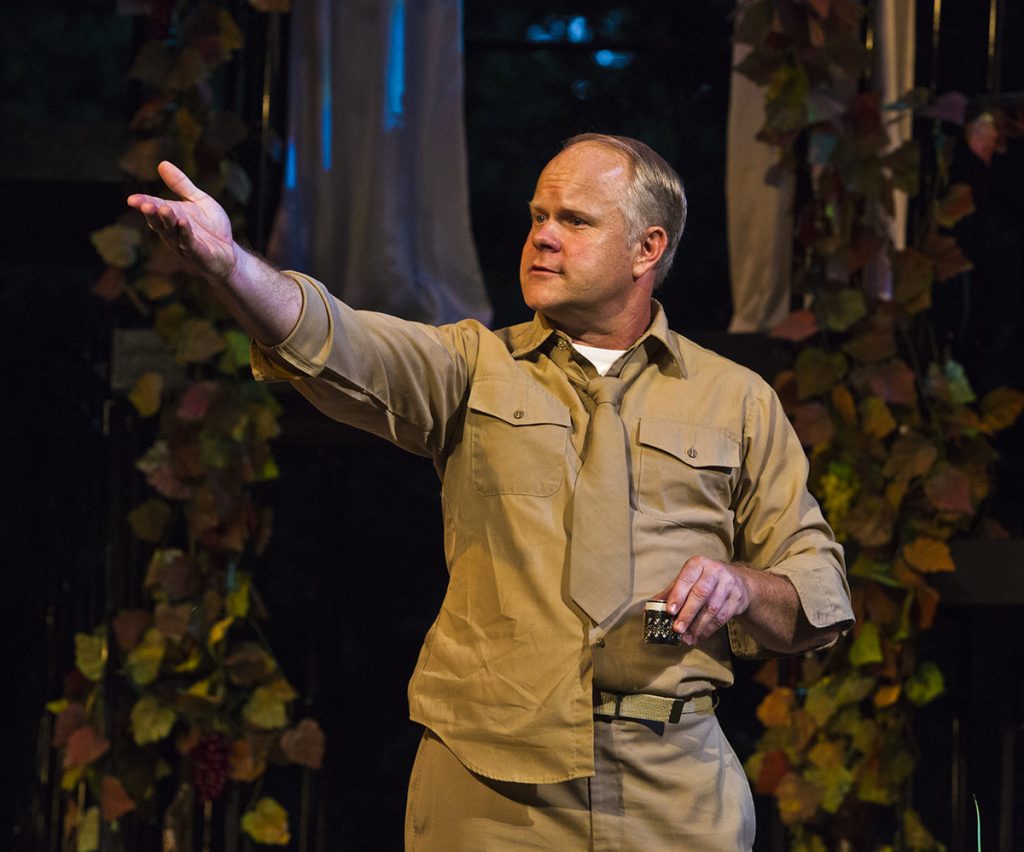
In 2015 Laura Gordon set the play in a post–World War II context, specifically in 1945 at the moment when soldiers were returning home. This historical framing allowed the production to explore a society in transition, particularly in relation to gender roles. Gordon was interested in a period when women had experienced increased independence during the war but were beginning to be pushed back into traditional roles, creating what she described as an “interesting gender battle” that shaped the dynamics of the play. One of the most striking interpretive choices was the transformation of Messina into a matriarchal household. Instead of Leonato and Antonio, the production featured Leonata (Patty Gallagher) and Antonia (Suzanne Sturn), reconfiguring the family structure around female authority. This shift foregrounded questions of gender and power, challenging the traditionally patriarchal framework of Shakespeare’s text. The casting emphasized gender parity and expanded opportunities for women performers, but some reviewers questioned whether removing the patriarchal structure weakened the play’s analysis of male psychology and its impact on both men and women.
The production’s design complemented its thematic concerns. Nina Ball’s set placed the action on the front lawn of Leonata’s estate, featuring benches arranged in a “V”-shape and a balcony overlooking the space. The open, metal-framed façade, adorned with flowers, allowed audiences to see action unfolding behind the central entrance, reinforcing the play’s emphasis on overhearing and misinterpretation. This spatial arrangement made the mechanics of deception and eavesdropping visually explicit, aligning with the play’s comedic structure. Critically, the production was well received for its clarity and performances. Reviewers especially praised Greta Wohlrabe’s Beatrice and Mike Ryan’s Benedick, noting that their delivery made Shakespeare’s language accessible and engaging for contemporary audiences. The production was widely regarded as “a must-see,” balancing humor, accessibility, and provocative reinterpretation.